How to Make Less Lethal Deployment Better with Ballistic Testing
Less-lethal weapons provide law enforcement with lower-risk alternatives for scene control, compliance and deterrence without causing permanent harm. What many misunderstand, however, is that less-lethal does not mean non-lethal. The reality is that any object propelled with high energy runs the risk of causing serious injury without the right deployment and safety standards in place.
Ballistic testing of less-lethal projectiles is crucial to establish injury thresholds, especially in dynamic scenarios where distance, trajectory, or target location may vary. At Biokinetics, we understand these challenges associated with the use of less-lethal weaponry for law enforcement and security purposes. Below, we will explore how ballistic testing helps navigate these challenges, as well as the benefits of partnering with our team.
The Challenge: Measuring “Safe” Impacts
Whereas traditional ballistic testing assesses performance based on penetration or resulting blunt trauma of the projectile, less-lethal testing typically addresses the realm of non-life threatening injuries, including:
- Skin penetration and deep tissue disruption that could lead to vascular and organ damage.
- Blunt impact trauma associated with injuries to the organs and skeletal system involving compressive and dynamic effects.
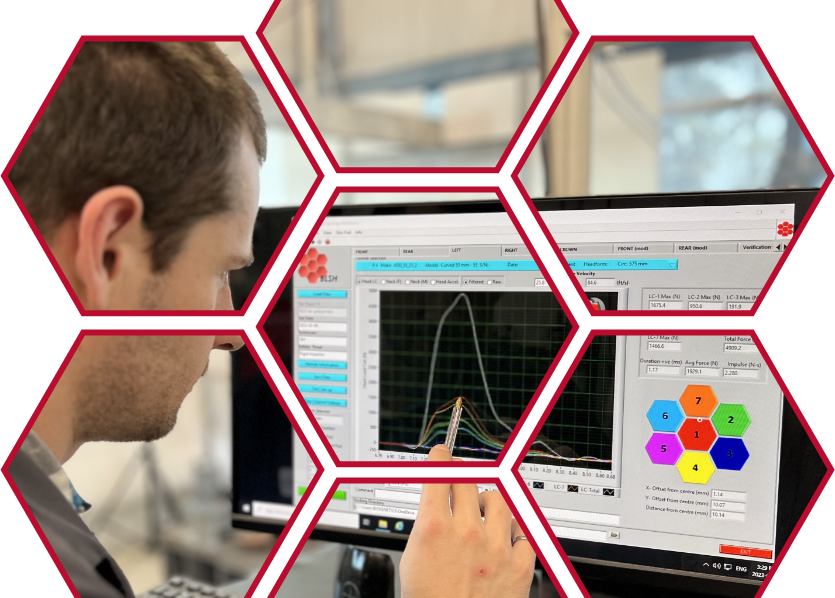
To understand the risks associated with blunt force trauma, simply measuring the static deformation on a witness medium such as clay is not sufficient as it is still possible to sustain injuries from high rate impacts without large deformations. To more accurately assess injury risks, testing is conducted using biofidelic (i.e. humanlike) targets that sufficiently replicate the human response under dynamic loading conditions. Test devices, such as the Blunt Trauma Torso Rig (BTTR), allow for the measure of simulated human response, and hence, injury risk can be assessed. Additionally, impact testing must ensure that the strike speed and yaw angles are accurate by using calibrated instruments and high speed data recording systems.
With a better understanding of the injury risks, and when combined with accuracy and speed data, guidance can be obtained for:
- Defining the “safe” distance at which the less-lethal rounds can be used without putting the public at risk.
- Identifying the operational range where the ammunition provides the desired effect within acceptable risks.
- The distance where the less-lethal round becomes ineffective.
The Biokinetics’ Approach to Less-Lethal Testing
At Biokinetics, we understand the importance of accurate, repeatable and reproducible less-lethal testing to answer questions regarding the factors discussed above. We leverage decades of industry-leading experience and specialized lab environments to provide the assessment of:
- Less-lethal impact speeds at various engagement distances.
- The kinetic energy and impulse of rounds across the range of engagement speeds.
- The effect of impact on injury risks based on biofidelic test devices for the torso and head.
- Tissue-level injury risk assessment using skin ad tissue surrogates.
- The kinematics of impact describing the impact deformations, velocity, energy transfer.
Using standardized and custom test rigs, we simulate realistic impacts across different body zones, allowing our clients to understand how less-lethal ammunition design, range, and materials affect outcomes. We also test new weapon configurations under multiple conditions to examine worst-case scenarios and edge-of-envelope behaviour. We are proud to be at the forefront of safety and to provide data that matters!
Why This Matters for Law Enforcement and Procurement
Agencies that deploy less-lethal systems face increasing pressure to demonstrate accountability, both from the public and municipalities. Without clear testing data, operators risk improper deployment and departments may face resistance when it comes to procurement. Ballistic testing for non-lethal weaponry helps to support operational readiness by identifying systems that meet internal safety thresholds and align with use-of-force policies. It also provides technical documentation that supports training, deployment planning and public communication.
For manufacturers of less-lethal armaments, rigorous testing provides an opportunity to refine product design, validate safety performance, ensure consistency in performance, and satisfy evolving customer and regulatory expectations.
Driving Toward a More Measurable Standard
One of the major hurdles in the non-lethal space is the absence of a universal standard for injury thresholds. While the NIJ does offer guidelines for less-than-lethal weapons, internal agency guidelines and published studies, we still lack a consistent framework for cross-jurisdictional testing with standardized performance targets. This makes it even more important for all stakeholders to demonstrate their best efforts at ensuring human safety.
At Biokinetics, we are proud to advance safety and bridge the gaps between the scientific evidence, design intent and operational performance. Our work provides manufacturers and law enforcement agencies clear test results and also contributes to the long-term development of test standards that can help guide the industry forward. The key to safety is understanding, and our team knows just how powerful the right knowledge can be.
Discover Test Results You Can Trust
Biokinetics offers a full suite of low, medium and high-speed testing services to support safer, and more informed deployment decisions. Contact us to learn more.