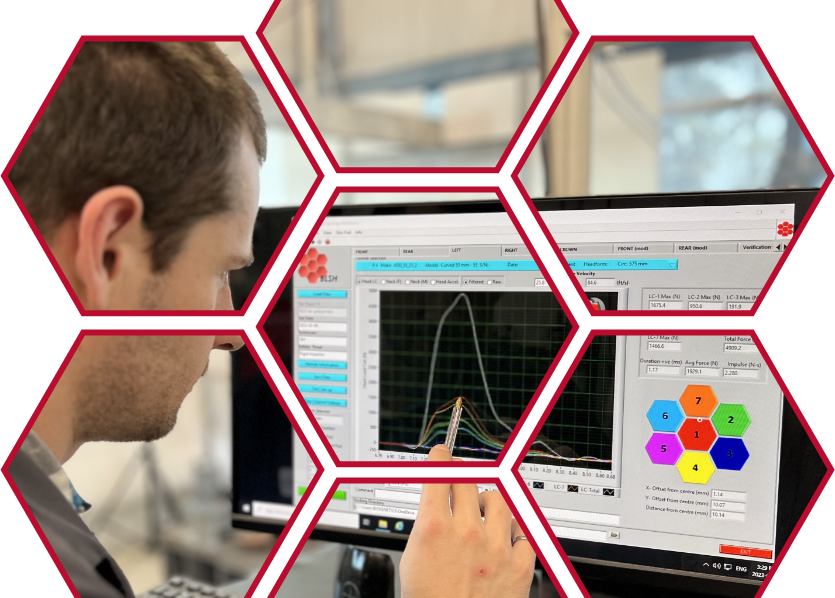
Protecting the brain is essential when playing contact sports. Helmets are one of the most important pieces of protective equipment for athletes, and are designed to absorb impact energy and spread the contact force over a larger footprint to reduce the risk of skull fracture and traumatic brain injury. Moderating an impact to a lesser level may also help reduce the risk of concussion.
At Biokinetics, we’re proud to provide industry-leading head impact testing to help ensure that helmets in use and in development can protect athletes when it matters most. With new technology and models constantly evolving, sports safety remains a fast-moving field, and the inclusion of new materials like Polyurethane (PU) foam shows promise in lowering the risks of injury even further.
Below, we’ll cover specific details of interest regarding the inclusion of PU foam and the benefits of partnering with Biokinetics for testing. Read on to learn more.
Understanding Shock Absorption: Protecting the Brain from Impact
Shock absorption is a critical aspect of helmet design. When a player experiences a sudden impact, a helmet must reduce the force acting against the cranium and the motion transferred to the brain. This is accomplished by ensuring the design and materials used can absorb the kinetic energy from the collision and spread the force it across a larger area, lowering the G-load that the brain experiences (which we’ll explore momentarily). With studies increasingly indicating that head injuries have lasting effects both physically and neurologically, protecting the brain is more important than ever. Manufacturers and regulators alike must find ways to ensure that modern designs adapt to our growing understanding of new data.
How Polyurethane Elastomers Are Changing Helmet Safety
PU elastomer is a high-performance viscoelastic material used in helmets because it efficiently absorbs and dissipates energy. Unlike traditional foam, which might compress and quickly rebound after an impact, PU foam deforms more gradually, converting impact energy into heat. This process helps to reduce the intensity of the forces transmitted to the wearer, providing a more effective (and comfortable) cushion against impact. Low rebound is a desirable feature in any impact absorbing product, because it absorbs the kinetic energy and reduces the overall velocity change of the head on impact, which in turn reduces the potential for brain tissue disruption. Another property of many PU foams is their ability to recover completely in the minutes following an impact, performing the same in repeated impacts.
Notably, PU’s viscoelastic properties enable it to adapt to different impact scenarios, potentially offering superior protection across a range of collision intensities—from low-energy taps to high-speed impacts. Due to its strain rate sensitivity, PU is also particularly effective for helmets. At higher speeds, such as those found in sports like football or rugby, PU becomes stiffer, improving its ability to absorb more impact energy and making it ideal for applications that run the risk of high-velocity collisions. On the other hand, rate sensitive materials are often temperature sensitive as well, whereby extreme heat softens the material and extreme cold hardens the material. Designers must thread the needle between these factors to find materials that work within the design and test specifications for a given product.
Regardless, the impact absorbing performance of PU foams offer promise for mitigating the threat of severe head injuries for athletes; as trusted sports equipment testers like Biokinetics continue to gain better knowledge about additional impact factors, like the difference between linear and rotational force, PU foam’s usage becomes even more paramount for creating a safer path forward.
Reducing the G-Load: Maximizing Protection
As we mentioned above, one key goal in helmet testing is to measure the G-loading transferred to the human head upon impact. Less is better, since the goal is to impart the lowest acceleration to the head as possible. G-load expresses the acceleration imparted to the head in multiples of gravitational acceleration, and is a proxy for the force imparted to the head. While most test standards accept the maximum threshold for head acceleration in the range of 250G to 300G, it is widely accepted that this territory is a survival limit only. Injury thresholds for concussion, for example, occur at much lesser limits, typically around 90G or less.
One of the core challenges facing manufacturers, however, is creating products that can withstand significant impacts without compromising player safety and staying comfortable and efficient during play. PU is ideal for this due to its ability to be molded in any shape, allowing design freedom to shape the padding to the players head. Having better shaped padding means that less comfort foam is needed, allowing for thicker layers of PU impact foam. The thicker the foam, the lower the G-loading possible. The use of PU elastomers in 3D printed padding materials has also gained traction, not only due to their desirable impact attenuating properties, but due to its flexibility in helmet designs not possible with traditional foams. Simply put, PU’s unique impact properties allow it to handle greater G-loads without compromising its effectiveness.
The Future of Helmet Safety: Integrating Advanced Testing and Materials
As helmet technology continues to evolve, materials like PU remain a core focus for manufacturers, regulators, and even athletes. It’s crucial to note that materials alone do not make a helmet safe. For optimal performance when it matters most, comprehensive head impact testing is essential.
At Biokinetics, our team leverages decades of experience, top-notch laboratories and predictive models to evaluate helmet designs, ensuring they offer the best protection. Our testing protocols include real-world impact scenarios to measure the effectiveness of helmet materials like PU under various impact and temperature conditions, allowing us to refine designs and provide the most accurate and trust-worthy results possible.
Leading the Way in Helmet Safety Testing
At Biokinetics, we are dedicated to providing the most accurate and reliable head impact testing services possible. Our expertise in advanced materials like PU and our cutting-edge testing methods ensure that helmets meet the highest safety standards and provide superior protection for athletes.
We are proud to work closely with manufacturers to fine-tune helmet designs, providing comprehensive data analysis to improve performance and comfort. Whether you’re developing new materials, refining existing designs, or testing prototype helmets, Biokinetics is your trusted partner in achieving better safety outcomes!
Don’t leave player safety to chance.
Partner with Biokinetics today to ensure that your helmets meet the highest safety standards through comprehensive head impact testing. CONTACT US NOW