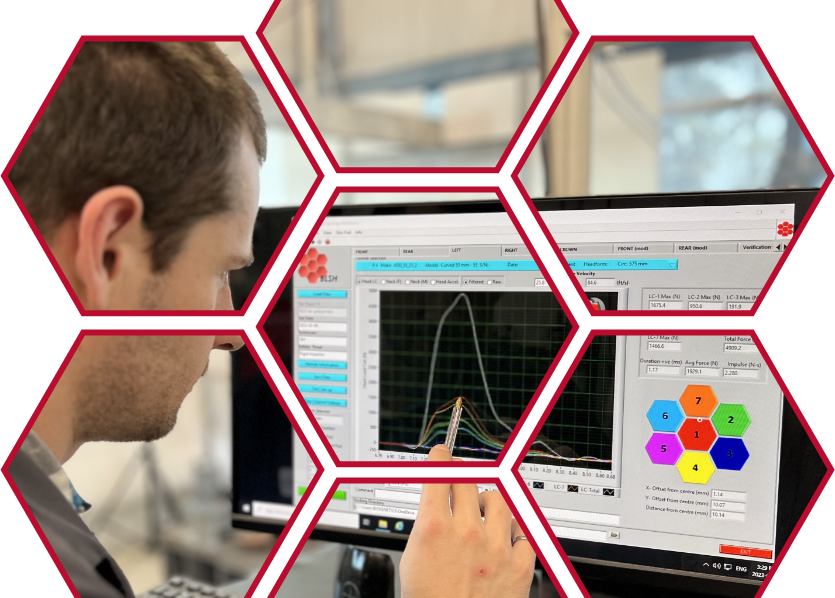
Law enforcement officers face many threats while navigating high-pressure situations on the job. When risk is an ever-present factor, protective gear is crucial for safety. While we often focus on the dangers associated with firearms and blades, blunt force trauma is a constant threat encountered during crowd control, tactical operations, and physical altercations.
Padded protective equipment is widely used across multiple sectors, including corrections, law enforcement, security and other branches to meet a wide range of needs, including absorbing energy and reducing the severity of impact energy. Unlike ballistic or stab-resistant systems like Kevlar, however, padded equipment isn’t typically held to the same standardized performance metrics for safety. Without having a set standard to be held to, padded equipment runs the risk of being less effective than required against blunt trauma, leaving wearers unnecessarily vulnerable when it matters most.
At Biokinetics, we understand how crucial reliable data is when it comes to protecting law enforcement officers and those who require protective padding to function safely in their professional environment. Below, we’ll explore the importance of blunt force testing and highlight how protective padding safeguards wearers. Read on to learn more.
Blunt Force: A Daily Operational Threat
While ballistic threats are often the top concern, low-mid-energy impacts make up the vast majority of physical interactions for law enforcement officers. Strikes, falls, and close-quarters contact present a serious threat of bodily harm for officers from encounters like:
- Blows from fists, feet, or blunt objects
- Hard-surface impacts during restraint or takedown
- Repetitive loading during crowd containment or training exercises
In these situations, officers rely on padded garments for protection across vulnerable areas like the ribs, shoulders, arms, and hips. Insufficient protection can often result in contusions, sprains, soft tissue injuries, or fractures. Untested gear runs a much higher risk of failing to perform in such scenarios and elevates the chances of injury and related issues occurring.
What Blunt Trauma Testing Evaluates
At Biokinetics, our testing protocols for body padding are designed to replicate the mechanical and anatomical conditions of real-world use. We specialize in accurately assessing force transfer and developing quantifiable plans for risk mitigation.
Using drop towers, guided impact systems, and biofidelic test surrogates, our team assess key data points like:
- Peak impact force transmitted beneath the padding
- Energy attenuation and dissipation characteristics
- Load distribution across curved or articulated body surfaces
- Consistency of performance over repeated impacts
This level of detail helps agencies and manufacturers identify whether gear is functionally protective and able to perform when officer safety is at stake.
The Role of Test Equipment
To measure blunt impact performance accurately, the test setup must reflect the human body’s response to force. That means using surrogates with tissue- and bone-representative stiffness, as well as geometry that matches common wear areas. Whether the goal is to validate a specific garment or compare multiple designs, the results must be clear, actionable data that reflects how gear behaves under realistic loads.
Biokinetics leverages decades of industry experience to adapt test configurations based on threat type, padding application, and operational requirement for optimal results that make a difference.
Procurement, Performance, and Accountability
Without standardized benchmarks, evaluating padded gear often comes down to subjective assessments—comfort, appearance, and perceived durability. Blunt trauma testing brings objectivity to the process by presenting a valid method of comparison for products and helps manufacturers optimize evolving designs using real-world impact data.
Evaluate Padded Protective Systems Confidently
Biokinetics offers testing services tailored to real-world conditions, grounded in biomechanical expertise and supported by industry-grade instrumentation. Contact us today to learn more!